
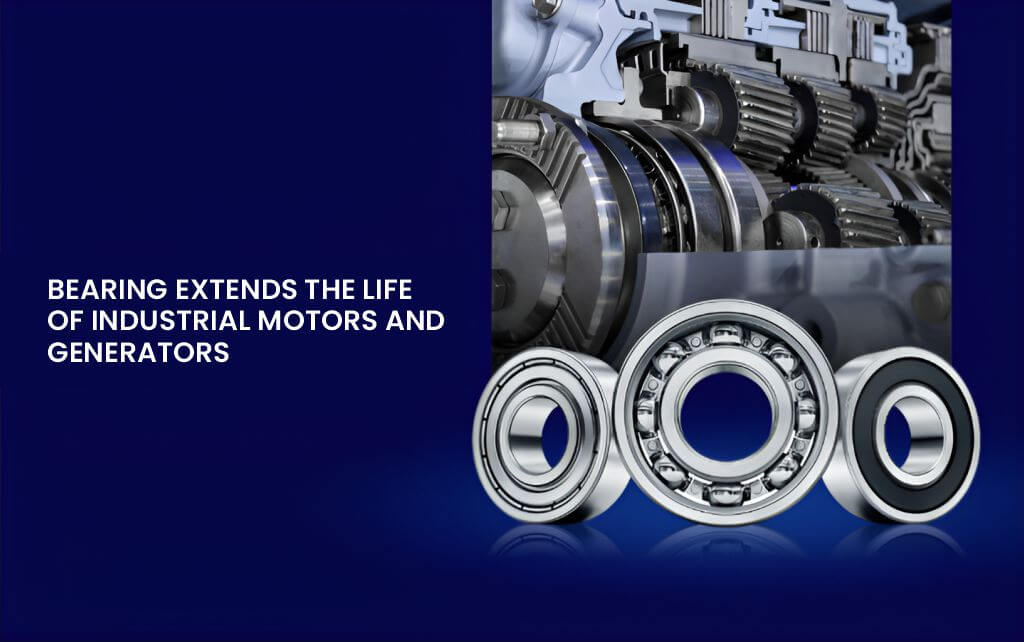
In every power plant, whether it runs on coal, natural gas, hydro or vent, motors and generators are the real workhorses. They keep electricity flowing, machines running, and also ensure energy systems are efficient. But behind the smooth operation lies a small but really powerful component that often doesn’t get enough attention. Bearings can help you or motors and generators spin freely, reduce friction, and carry loads while staying in alignment. Choosing the right bearing and installing it properly can extend the life of your equipment and reduce downtime while saving money.
Common Bearing Types Used In Motors
Different types of motors and applications call for different bearings. You cannot just pick any bearing and hope for the best.
Deep groove Ball bearings are perhaps the most common and versatile type of bearings that can be used in electric motors. They handle both sideways and light loads. They are completely efficient and suitable for high-speed applications. The bearings are often used in fan blowers and general-purpose motors. You can generally find them in power plants.
Angular contact ball bearings are designed to handle higher axial loads as compared to deep groove ball bearings. They are used where motors or generators experience both radial and axial forces. They are generally found in turbine generators and boiler feed pumps.
Cylindrical roller bearings are heavy-duty bearings made for high radial loads. They basically work well in applications where the shaft experiences a heavy load but little axial movement.
Spherical roller bearings are just perfect when misalignment is an issue. Power plant environments can be really rough with vibrations and structural shifts. The bearings completely self-align and absorb shock. You can use it in turbine shafts and hydropower plants.
Tapered roller bearings handle both radial and axial loads and are common in applications where the shaft position needs to be perfectly controlled. Typical uses include gearboxes in motors and large alternators.
Insulated Bearings To Prevent Electrical Damage
A lot of power plants today use variable frequency drives to control motor speeds and improve efficiency. No doubt, the technology is great, but it introduces a new problem: electrical currents flowing through bearings. These stray currents can cause electrical discharge machining. This happens when electricity arcs across the bearing Surface, leaving tiny pits. At times, this can lead to noise and vibration.
What Are Insulated Bearings?
They are specially designed to block electric current. You can do it in two ways: with ceramic coating and hybrid bearings. Ceramic coating is a non-conductive ceramic layer that is applied to the outer and inner rings of your bearing. Furthermore, hybrid bearings generally use ceramic balls instead of steel. Ceramic is naturally non-conductive and lightweight, which helps you reduce the risk of electrical damage and wear.
Deep Groove Ball Bearings For General Motors
When it comes to standard motors because throughout power plants like the fans, small pumps, and blowers, deep groove ball bearings are your best bet. They are really prominent because of the simple and compact design and high speed quality, and quiet operation. They are ideal when you don’t have extremely high loads or misalignment problems. But you need to ensure that they are properly lubricated and aligned during installation. Some of the most common uses include motor-driven cooling fans and exhaust fans. Even though they are completely simple, deep groove ball bearings can last a long time if properly maintained, often more than 10 years in continuous service environments.
Use Cases
Generators convert mechanical energy into electrical energy. Bearings can help the rotor spin freely while carrying radial and axial loads. Large steam turbine generators basically use journal bearings because of their high load capacity. Gas turbine generators often use a combination of sleeve bearings and ball bearings to handle both forces. In every case, you need to ensure that the getting must resist heat and vibration and also handle every high-speed rotation.
Alternators are typically smaller as compared to full-scale generators, and they can be used in backup systems for additional power loads. They can be mounted on diesel engines or turbines. Common bearings used include deep groove ball bearings and tapered roller bearings. You must know that alternators and backup power systems might not run all the time, but when they do, they must perform well.
So, in short, you need to know that bearings might be really small, but they are very important to the health and life of your motors and generators in power plants. Choosing the right bearing for the job, whether it’s a simple deep groove ball bearing or a ceramic insulated hybrid bearing, can dramatically reduce your downtime and also heat and vibration. More importantly, it ensures uninterrupted power generation, which is the backbone of your energy facility.