
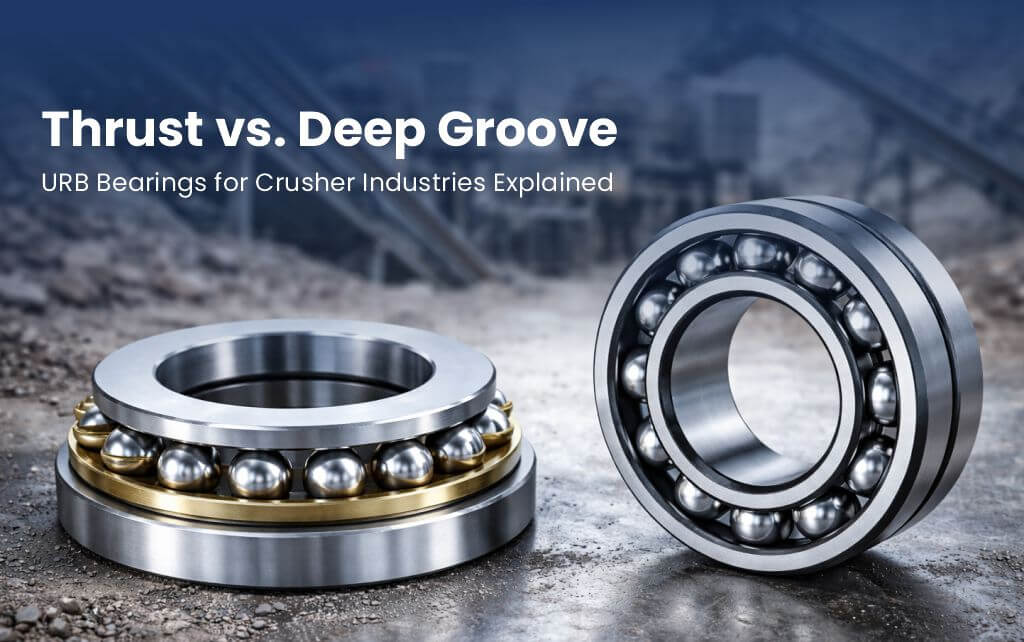
In crusher industries, bearings are not just supporting components. They directly affect uptime, load handling, maintenance costs, and overall machine life. A wrong bearing choice can lead to frequent breakdowns, overheating, or unexpected shutdowns. That is why understanding the difference between thrust bearings and deep groove ball bearings is critical for crusher operators, plant managers, and maintenance teams.
URB Bearings have earned strong trust in heavy-duty applications, especially in mining and crushing environments where shock loads, dust, and continuous operation are the norm. This article explains the key differences between thrust and deep groove URB bearings, their working principles, real-world crusher applications, and how to choose the right option. It also highlights how S. Goel Bearing & Co., a leading URB Bearings importer in India, supports crusher industries with genuine products and technical guidance.
Understanding Bearing Requirements in Crusher Industries
Crusher machines operate under extreme mechanical stress. Jaw crushers, cone crushers, impact crushers, and roll crushers all generate heavy radial and axial loads. These loads vary depending on material hardness, feed size, and operating speed.
Common challenges faced by crusher bearings
- Continuous exposure to dust and debris
- High vibration and shock loads
- Elevated operating temperatures
- Heavy radial and axial forces are acting simultaneously
- Limited lubrication intervals
Because of these conditions, crusher industries rely on bearings that offer durability, load stability, and consistent performance. URB bearings are often chosen due to their proven metallurgy, precision manufacturing, and long service life in harsh industrial settings.
What Are URB Thrust Bearings and How They Work
Design and load direction
Thrust bearings are designed to handle axial loads, meaning loads acting parallel to the shaft. They are not meant to support radial loads and are usually paired with another bearing type when both load directions exist.
URB thrust bearings typically consist of:
- Shaft washer
- Housing washer
- Rolling elements (balls or rollers)
- Cage for element spacing
Where thrust bearings fit in crusher setups
In crusher industries, thrust bearings are commonly used in:
- Vertical shafts
- Adjustment mechanisms
- Gearbox assemblies
- Screw conveyors attached to crushers
For example, in cone crushers, thrust bearings help manage vertical loads created during crushing and pressure adjustments.
Key advantages of URB thrust bearings
- High axial load capacity
- Reduced friction during axial movement
- Stable shaft positioning
- Reliable performance under continuous thrust forces
However, they must be installed carefully, with proper alignment and lubrication, to avoid premature wear.
What Are URB Deep Groove Ball Bearings and How They Perform
Design and load handling
Deep groove ball bearings are among the most versatile bearing types used in the crusher industries. They are designed to handle radial loads primarily, while also supporting moderate axial loads in both directions.
URB deep groove bearings feature:
- Deep raceway grooves
- High precision steel balls
- Robust cages for stability
Applications in the crusher industries
Deep groove URB bearings are widely used in:
- Conveyor systems feeding crushers
- Crusher motors
- Flywheels
- Auxiliary equipment, such as screens and feeders
They are especially effective in high-speed applications where low friction and quiet operation are important.
Advantages of URB deep groove bearings
- Simple and robust design
- Low maintenance requirements
- High-speed capability
- Long operating life when properly lubricated
Because of their flexibility, deep groove bearings often serve as a standard choice for many crusher components.
Thrust vs. Deep Groove Bearings: Key Differences Explained
Understanding the difference between these two bearing types helps avoid costly mistakes.
Load direction comparison
- Thrust bearings: Handle axial loads only
- Deep groove bearings: Handle radial loads and limited axial loads
Speed capability
- Thrust bearings generally operate at lower speeds due to load concentration
- Deep groove bearings are suitable for higher rotational speeds
Installation considerations
- Thrust bearings require precise alignment and surface accuracy
- Deep groove bearings are easier to install and replace
Typical failure causes
- Thrust bearings often fail due to improper lubrication or misalignment
- Deep groove bearings may fail due to overloading or contamination
In crusher industries, using a thrust bearing where radial load dominates or using a deep groove bearing where axial load is excessive can lead to early failure.
Choosing the Right URB Bearing for Crusher Applications
Selecting the correct bearing depends on understanding operating conditions rather than choosing based on price or availability.
Factors to evaluate before selection
- Load type and magnitude
- Shaft orientation
- Operating speed
- Temperature range
- Environmental contamination
Practical selection examples
- A vertical shaft adjustment system in a cone crusher benefits from URB thrust bearings due to dominant axial loads.
- Conveyor rollers and crusher motors perform better with URB deep groove ball bearings because radial loads and speed are higher.
Many crusher plants use a combination of thrust and deep groove bearings to balance axial and radial forces efficiently.
Why URB Bearings Are Trusted in Crusher Industries
URB Bearings are known for consistent quality and performance in heavy-duty environments. Their manufacturing standards focus on material strength, dimensional accuracy, and surface finish.
Key reasons crusher industries prefer URB
- High-quality bearing steel for shock resistance
- Precision machining for reduced vibration
- Reliable performance in dusty and high-load conditions
- Competitive pricing compared to other global brands
As a result, URB bearings for crusher industries continue to gain preference across mining, aggregate, and cement sectors.
Role of S. Goel Bearing & Co. in Supplying URB Bearings in India
- Goel Bearing & Co. has built a strong reputation as a leading URB Bearings importer in India, serving the crusher industries with genuine products and technical support.
Value offered to the crusher industries
- Wide stock of URB thrust bearings and deep groove bearings
- Assurance of authentic and tested products
- Technical guidance for correct bearing selection
- Timely delivery to minimize downtime
With decades of industry experience, S. Goel Bearing & Co. understands the real operating challenges faced by crusher plants and recommends bearing solutions that improve reliability and service life.
Maintenance Tips to Extend Bearing Life in Crushers
Even the best bearings need proper care to perform well in the crusher industry.
Recommended best practices
- Use the correct lubrication grade and intervals
- Protect bearings from dust and moisture ingress
- Avoid overloading beyond design limits
- Monitor vibration and temperature regularly
Proper maintenance can significantly extend the life of both thrust and deep groove URB bearings, reducing replacement costs and unplanned shutdowns.
Conclusion:
Choosing between thrust and deep groove bearings is not about which one is better, but which one is right for the application. Crusher industries operate in demanding conditions where bearing performance directly impacts productivity and cost control. URB bearings offer dependable solutions for both axial and radial load requirements when selected correctly.
For crusher operators seeking genuine products, expert advice, and consistent supply, S. Goel Bearing & Co. stands as a trusted URB Bearings importer in India. By partnering with an experienced supplier and using the right bearing type, crusher plants can achieve longer service life, smoother operation, and improved overall efficiency.
For reliable URB bearings for crusher industries, reaching out to S. Goel Bearing & Co. is a practical step toward stronger and more dependable machinery performance.