
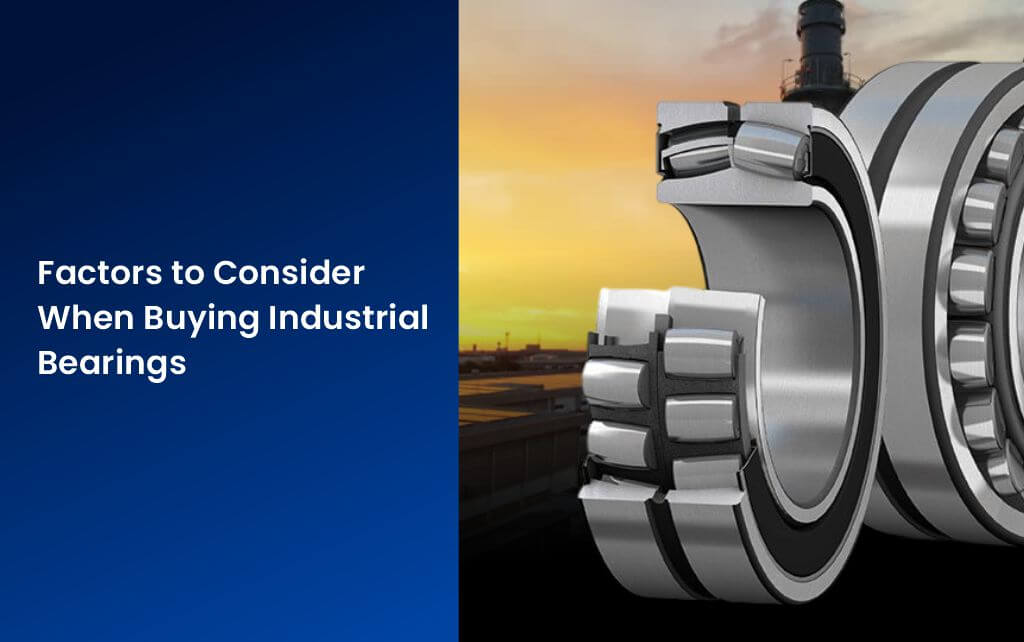
Every plant shutdown, every seized spindle, every unplanned maintenance call shares a common thread: somewhere upstream, a bearing was incorrectly selected, improperly specified, or bought purely on price. In more than two decades of supporting industrial purchasing decisions across steel plants, paper mills, food processing lines, mining operations, and automotive assembly floors, I have watched this pattern repeat itself with remarkable consistency. The bearing is rarely the cheapest component in a machine, but it is almost always the one whose failure costs the most.
Industrial bearing selection is not a catalogue exercise. It requires understanding how a machine actually operates, what stresses it generates, how its environment behaves, and what the real cost of stopping production is. Buying industrial bearings without that understanding is how maintenance departments end up replacing a bearing four times in a year that should last four years.
This guide exists to close that gap. Whether you are an engineer specifying bearings for a new installation, a maintenance manager reviewing your MRO procurement, or a workshop owner sourcing replacements for equipment in the field, these are the factors that determine whether your bearing performs or fails. Read them not as a checklist, but as a framework for making decisions that protect your equipment, your uptime, and your bottom line.
Industrial bearing selection that ignores application reality is not selection at all. It is an educated guess with expensive consequences.
1. Understanding Load: Type, Direction, and Magnitude
Load is the starting point for every bearing selection decision, and it is also where the most damaging misunderstandings occur. In industrial purchasing, the most frequent oversight we encounter is treating load as a single number: the static maximum load the machine might theoretically generate. Real applications do not produce static, predictable loads. They produce dynamic, fluctuating forces that act in multiple directions simultaneously.
Radial vs. Axial Loads
Radial loads act perpendicular to the shaft axis. Axial loads, also called thrust loads, act along the shaft axis. Most real applications produce a combination of both, and the ratio between them governs which bearing type is appropriate. A deep groove ball bearing handles moderate combined loads well. A cylindrical roller bearing handles heavy radial loads but very limited axial forces. Angular contact bearings are built specifically for applications where axial loads are significant and directional. Tapered roller bearings manage heavy combined loads across a wide speed range.
When buyers bring us a failed bearing and describe it simply as ‘it keeps breaking,’ the first question is always: what loads does this bearing actually see? Nine times out of ten, the bearing was selected for radial load only, and the machine was generating substantial axial thrust that the bearing was never designed to carry. The internal geometry simply was not built for it, and the raceways fail prematurely.
Dynamic vs. Static Load Ratings
Every bearing carries two rated load values. The dynamic load rating, designated C, is used for rotating applications and predicts bearing life based on fatigue. The static load rating, designated C0, applies when the bearing is stationary or rotating very slowly. Selecting only against dynamic rating is appropriate for most rotating machinery, but applications with heavy shock loads at low speed, or applications where a shaft stops under load, require careful evaluation of the static rating.
Across decades of supporting plant operations, the most consistent error in procurement is buying on dynamic rating alone for slow-speed, heavy-duty equipment such as kiln drives, large press applications, and hydraulic actuators. These machines generate peak loads that exceed the dynamic rating before the shaft even completes a revolution. The correct approach requires checking both ratings against the actual loading profile.
Shock Loading and Variable Load Profiles
Many industrial processes produce shock loads, impact forces, or highly variable loading that a nameplate rating does not capture. Rolling mills, crushers, vibrating screens, and reciprocating compressors all generate load patterns that must be accounted for through an application factor. Ignoring shock and variable loading consistently produces bearing lives far shorter than calculated. When a maintenance team reports that ‘the bearings never last as long as the catalogue says,’ a shock load calculation they have never performed is usually the explanation.
2. Speed Requirements: Operating Speed, Limiting Speed, and Thermal Implications
Speed is the second major parameter in choosing the right bearing, and it is more nuanced than simply checking whether a bearing’s limiting speed exceeds the application’s operating speed. Limiting speed is a function of bearing geometry, lubrication type, cage material, and thermal management. Operating near or at limiting speed without addressing all of these variables reliably produces premature failure.
Reference Speed vs. Limiting Speed
Modern bearing specifications carry two speed values. Reference speed defines the operating speed at which a bearing achieves a specific thermal equilibrium under defined conditions. Limiting speed is the absolute mechanical ceiling above which cage damage, lubricant breakdown, or thermal failure becomes likely. Procurement teams that treat limiting speed as the operating target are building in failure from day one. A conservative operating margin of 70 to 80 percent of limiting speed, maintained under proper lubrication, reflects real-world best practice.
High-Speed Applications and Bearing Type
As speeds increase, the centrifugal forces on rolling elements grow significantly. Ball bearings tolerate high speeds better than roller bearings because the rolling element contact area is smaller and generates less heat. Angular contact ball bearings in matched-pair or back-to-back arrangements are the standard solution for high-speed spindle applications. Cylindrical roller bearings with precision cage designs handle moderately high speeds under heavy radial loads. Needle roller bearings provide high radial load capacity in confined spaces but require careful speed management.
In industrial purchasing, we regularly see high-speed spindle applications where a buyer has replaced a precision angular contact bearing with a standard deep groove ball bearing to reduce cost. The cost saving is real and immediate. The failure, three to six weeks later, is also real and far more expensive. Speed and precision requirements are non-negotiable parameters, not areas for value engineering.
Speed and Lubrication Compatibility
Grease lubrication has a practical speed ceiling that varies with bearing size and type. Above that ceiling, grease churning generates heat faster than it dissipates, and the lubricant breaks down rapidly. Oil lubrication, whether through oil bath, oil mist, oil jet, or circulating systems, extends the speed range significantly. Buying a bearing appropriate for the load and speed without addressing the lubrication method is an incomplete decision. Speed selection and lubrication selection are inseparable.
3. Temperature Range: Operating Conditions and Material Implications
Temperature directly affects bearing material properties, clearance behaviour, lubricant performance, and seal integrity. Ignoring the thermal environment is one of the most consistent causes of bearing failure in industrial applications, particularly in continuous process industries where operating temperatures are either very high or very low.
Standard Operating Temperature Range
Standard bearing steels and heat treatment processes are qualified for operating temperatures up to approximately 120 degrees Celsius. Beyond this threshold, the tempering process used during heat treatment begins to reverse. Hardness decreases, dimensional stability degrades, and the bearing loses its rated load capacity. Applications that operate above 120 degrees Celsius require stabilised bearings, designated with a suffix that identifies the temperature at which they have been additionally heat treated.
In industrial purchasing, the most frequent temperature-related mistake we encounter is the assumption that an application’s nominal operating temperature is the bearing’s actual temperature. A motor running in an ambient temperature of 60 degrees Celsius, combined with the heat generated by friction and the thermal resistance of a poorly designed housing, can produce bearing temperatures of 130 degrees Celsius or more. Without temperature measurement, this remains invisible until failure occurs.
Low-Temperature Applications
Cryogenic and cold-environment applications present the opposite challenge. Standard grease becomes viscous and loses its ability to distribute and protect at very low temperatures. Bearing clearance must account for differential thermal contraction between inner ring, outer ring, rolling elements, and housing. Cold-temperature applications require low-temperature grease formulations and, in some cases, bearing steels with improved impact resistance at sub-zero temperatures.
Thermal Expansion and Clearance Interaction
As a bearing heats up during operation, the components expand. Inner rings, mounted on shafts, expand outward. Outer rings, contained in housings, are restrained. Rolling elements expand uniformly. This differential expansion reduces internal bearing clearance during operation. A bearing selected with standard clearance can end up operating with effectively zero or negative clearance at working temperature, generating excessive contact stress and accelerating fatigue.
The practical consequence is that applications with elevated operating temperatures require bearings with increased initial internal clearance. This relationship between temperature, clearance selection, and bearing life is one of the most consistently overlooked factors in industrial bearing selection, and it is one of the first things we examine when diagnosing repeated premature failures in furnace drive applications, dryer drum bearings, and kiln trunnion support arrangements.
4. Internal Clearance Selection: The Hidden Performance Parameter
Internal clearance is the total free movement of one bearing ring relative to the other, in both the radial and axial directions, before assembly and without applied load. It is one of the most technically important parameters in bearing selection and one of the least understood in industrial procurement. Specifying the wrong clearance contributes to premature failure more reliably than almost any other single factor.
The Standard Clearance Classes
Bearings are manufactured in defined internal clearance classes, ranging from C2 through C5. C2 bearings carry less than standard clearance and are specified for applications with light fits, elevated temperatures requiring tight running clearance, or precision applications where minimal play is required. C3 bearings carry greater than standard clearance and are specified for applications with interference fits on both rings, elevated operating temperatures, or significant external load from belt tension. C4 and C5 bearings carry still greater clearance and address heavy interference fits and very high operating temperatures.
The Interference Fit and Clearance Relationship
When a bearing inner ring is press-fitted onto a shaft, the interference causes the ring to expand outward. This expansion reduces the internal clearance by an amount proportional to the degree of interference. A bearing with standard clearance, fitted with a standard interference onto a steel shaft, may end up with virtually no internal clearance after assembly. Adding operating temperature into that equation produces a bearing running with negative clearance, which generates rapid raceway fatigue.
In industrial purchasing, the most frequent oversight we encounter in this area is procurement teams ordering standard clearance bearings for applications that combine interference shaft fits with elevated operating temperatures. The bearing is technically correct in most specifications, but the clearance is wrong for the actual application conditions. Correcting this alone eliminates a significant proportion of what maintenance teams describe as ‘unexplained bearing failures.’
The Cost of Over-Clearance
Selecting excessive clearance carries its own risks. Bearings running with too much clearance distribute load over fewer rolling elements, increasing contact stress per element. They also generate vibration and allow the shaft to move in ways that damage adjacent components. In precision machine tools and high-speed spindle applications, excessive clearance directly compromises machined surface quality. Getting clearance right means understanding the interference fit, the operating temperature, and the precision requirements together.
Clearance selection is not a default decision. It is a calculated one, and getting it wrong quietly destroys bearing life from the first revolution.
5. Lubrication Requirements and Sealing Configuration
Lubrication is the bearing’s primary protection against metal-to-metal contact, corrosion, and contamination. The lubrication decision encompasses not only whether to use grease or oil but which specific formulation, viscosity, and delivery method suits the application. Sealing is the lubrication’s guardian: without effective sealing, contamination destroys lubricant films and accelerates wear regardless of lubricant quality.
Grease Lubrication: Viscosity and Base Oil Selection
Grease consists of a base oil suspended in a thickener, plus additive packages. The critical parameter for bearing lubrication is the base oil viscosity. For a given bearing size and speed, there is a minimum viscosity required to maintain a full separating film between rolling elements and raceways. Operating below this minimum viscosity consistently produces smearing, adhesive wear, and early raceway fatigue.
A common procurement shortcut we see in maintenance environments is the use of general-purpose multipurpose grease across all bearing applications. This approach fails in high-speed electric motors where the grease churns excessively, in wet or humid environments where an inappropriate thickener absorbs water and loses film strength, and in high-temperature applications where the base oil evaporates faster than the relubrication interval allows. Application-specific grease selection is not over-engineering. It is basic application support.
Oil Lubrication Systems
Oil lubrication becomes necessary when operating speeds exceed the practical limit of grease, when heat removal from the bearing is required, or when continuous lubricant supply is critical to reliability. Oil bath lubrication provides continuous immersion but requires careful oil level control. Oil mist and oil jet systems deliver precisely controlled quantities to the bearing contact zone and are standard in high-speed and high-temperature industrial applications. Circulating systems allow continuous filtration and cooling, making them appropriate for heavy-duty continuous processes.
Specifying an oil-lubricated bearing arrangement requires defining not only the lubricant but the delivery system, the oil change interval, and the filtration standard. Buyers who select bearings intended for circulating oil systems and then install them in an oil bath arrangement consistently experience performance below specification.
Sealed vs. Open Bearings and Shield Options
Pre-greased sealed bearings are appropriate for applications where relubrication access is difficult, operating temperatures fall within the seal’s range, and speeds are within the sealed bearing’s limit. Shields offer lower drag at the cost of reduced contamination protection. Open bearings with external seals or labyrinth arrangements offer maximum flexibility for lubrication management and higher speed capability, but require more careful system design.
In industrial maintenance environments, the greatest sealing error we encounter is using pre-greased sealed bearings in applications that require relubrication due to high operating temperatures or contaminated environments. The bearing runs clean initially, then the original grease degrades, and because the seal prevents relubrication, the bearing fails on dry metal. The solution is either an open bearing with an external sealing arrangement and a relubrication programme, or a selection from the range of bearings with replaceable or relubrication-compatible seals.
Contamination Control and Its Bearing on Life
Contamination is the single most destructive factor in bearing service life in industrial environments. Solid contaminants, including dust, metallic debris, and abrasive particles, create denting on raceways and rolling elements. Each dent becomes a stress concentration point where fatigue initiates. Studies consistently show that contaminated lubrication reduces bearing life to a fraction of its calculated value under clean conditions. Hardness ratio between contaminant particle and bearing steel determines the severity of damage.
Buying industrial bearings for contaminated environments without addressing sealing and lubrication cleanliness is an investment in accelerated failure. The bearing specification in isolation is irrelevant if the operating environment degrades the lubricant within weeks of installation.
6. Dimensional Accuracy, Material Quality, and Manufacturing Precision
In industrial bearing procurement, dimensional accuracy and manufacturing quality are not optional upgrades. They are the parameters that determine whether a bearing actually achieves its rated performance in service. The market for bearings includes a very wide range of manufacturing quality, and the differences between a precision-manufactured bearing and a sub-standard one are invisible to the eye but immediately apparent in service life.
Bearing Tolerance Classes and Precision Grades
Bearings are manufactured to defined dimensional and running accuracy tolerance classes. Standard tolerance, the baseline for general industrial applications, provides adequate precision for most rotating machinery operating at moderate speeds. As speed and precision requirements increase, tighter tolerance classes become necessary. High-precision applications in machine tool spindles, precision grinding machines, and high-speed pumps require bearings manufactured to the tightest available tolerance classes, with controlled dimensional deviations measured in single-digit microns.
The error in industrial purchasing is ordering standard tolerance bearings for applications that require precision tolerance because the price difference is significant and the specification is buried in a document that procurement did not read. The consequence is a machine that vibrates, produces poor surface finishes, or generates noise far above acceptable limits. Specifying tolerance class correctly is not a cost item; it is a performance requirement.
Bearing Steel and Heat Treatment
Through-hardened bearing steel is the standard material for most industrial bearings. Case-hardened steel, used in specific designs, provides a tough core with a hard surface layer. Surface hardness in the Rockwell HRC 60 to 64 range governs contact fatigue resistance. Heat treatment to achieve and maintain this hardness must be controlled precisely. Bearings manufactured from inferior steel or with inconsistent heat treatment lose hardness in service, deform under load, and fail at a fraction of their calculated life.
Sub-standard bearing imports, of which the market receives a significant volume, consistently test at lower hardness levels than specification. Their dimensional tolerances also exceed the stated class limits. Neither failure is visible during incoming inspection without laboratory analysis. The consequence shows up three months later on the production floor. At S. Goel Bearing & Co., we source exclusively from manufacturers whose quality documentation, material traceability, and manufacturing process controls meet the standards our customers’ applications require.
Surface Finish and Roundness of Raceways
Raceway surface finish and geometry directly govern bearing noise, vibration, and running accuracy. A bearing’s internal noise floor is determined largely by the micro-geometry of its raceways and rolling elements. For vibration-sensitive applications, such as electric motor bearings used in precision environments, acoustic measurement of each bearing at the manufacturing stage is the correct standard. For general industrial use, raceway finish must meet minimum requirements that prevent accelerated wear of the lubricant film.
7. Environmental Exposure: Moisture, Chemicals, and Extreme Conditions
Industrial environments are not laboratory conditions. Bearings in food processing plants face regular washdown with hot water and caustic cleaning agents. Bearings in chemical plants operate in atmospheres that aggressively attack standard lubricants and materials. Offshore and marine applications combine high humidity, salt spray, and temperature cycling. Mining applications expose bearings to abrasive slurry, shock loads, and contaminated water. Each of these environments demands specific material and protection choices that a standard catalogue bearing cannot deliver without modification.
Corrosion Resistance Requirements
Standard bearing steel corrodes in humid environments. Pitting corrosion on raceways destroys surface finish and creates stress concentration points that trigger fatigue. For moderate humidity exposures, corrosion-inhibiting grease and appropriate sealing provide adequate protection. For aggressive environments involving direct water contact, chemical exposure, or outdoor installation without enclosure, stainless steel bearings, ceramic hybrid bearings with ceramic rolling elements, or bearings with specialised coatings become necessary.
In food and beverage processing, regulatory and hygiene requirements prohibit standard mineral-oil lubricants in bearing positions near open product. Food-grade lubricants with different viscosity and additive chemistry must be used, and these often require relubrication at shorter intervals than standard greases. Buying a standard bearing and simply greasing it with a food-grade lubricant overlooks the sealing requirements and relubrication access that successful food-industry installations require.
Chemical Compatibility
Bearing seals are commonly manufactured from nitrile rubber, a material that performs well in mineral oil environments but degrades rapidly in contact with many solvents, aggressive acids, and certain process chemicals. Applications involving such environments require seals manufactured from fluoroelastomer or other chemically resistant materials. Similarly, certain lubricant additives react adversely with bearing steel in specific chemical environments, accelerating corrosion rather than preventing it. Chemical compatibility assessment requires knowing the process environment, the bearing material, the seal material, and the lubricant chemistry together.
Extreme Pressure and Vacuum Applications
Applications in vacuum environments prevent the use of conventional lubricants that have measurable vapour pressure. High-vacuum applications in semiconductor manufacturing, electron beam processing, and precision optical equipment require specialised dry lubricants or very low vapour pressure oils that remain stable and functional in the operating environment. These are not standard procurement items and require specialist sourcing and application support.
High-pressure environments, such as those in hydraulic systems where the bearing is wetted by process fluid rather than dedicated lubricant, require compatibility between process fluid and bearing materials. This is particularly relevant in water-hydraulic systems, where standard greases wash out immediately and bearing material must be selected for performance in water rather than oil.
8. Housing and Shaft Compatibility: Fits, Tolerances, and Mounting Practicalities
Choosing the right bearing for a given load, speed, and environment is only half the selection process. The other half is ensuring that the bearing fits correctly into its operating environment. Incorrect shaft fits, incorrectly toleranced housing bores, and wrong mounting methods all defeat the performance of even a correctly specified bearing.
Shaft and Housing Fit Principles
The general principle in bearing mounting is that the rotating ring receives an interference fit and the stationary ring receives a sliding or light interference fit. For most shaft-mounted applications, the inner ring rotates with the shaft and receives an interference fit. The outer ring sits in the housing and receives a close sliding fit that allows controlled axial movement for thermal expansion.
The magnitude of interference required depends on load magnitude, bearing size, and the degree to which load direction is fixed or rotating relative to the outer ring. Getting the interference wrong in either direction produces problems. Insufficient interference allows the ring to creep on the shaft, generating fretting corrosion and eventual shaft damage. Excessive interference reduces clearance below the appropriate value for operating conditions, generating elevated running temperatures and accelerated fatigue.
Housing Bore Geometry and Surface Finish
A housing bore that is out of round, tapered, or rougher than specification deforms the bearing outer ring into a non-circular shape during mounting. This creates uneven internal clearance distribution around the ring circumference, concentrating load on specific rolling elements and accelerating fatigue. Checking and correcting housing bore geometry before installing replacement bearings is a basic maintenance practice that many workshops skip because it takes time. The consequence is a new bearing that begins failing from the moment it enters service.
In industrial purchasing, the question we raise with maintenance teams is: before you ordered a replacement bearing, did you check the housing bore? In many cases, the housing damage that caused the previous failure is still present and will cause the replacement to fail in the same way. The bearing is not the root cause; the housing is. Buying a new bearing into a damaged housing is not maintenance. It is deferred cost.
Adaptor Sleeves and Withdrawal Sleeves
Bearings with tapered bore accept mounting on tapered adaptor sleeves, which simplify installation on plain shafts and allow precise clearance setting by controlling the axial drive distance. This mounting method is widely used in plummer block and flanged bearing unit applications across the heavy industries. The critical parameter is driving the sleeve to the correct axial position, which corresponds to the target internal clearance reduction. Over-driving reduces clearance to the point of zero or negative internal play. Under-driving leaves excessive clearance and allows shaft movement.
A hydraulic nut is the correct installation tool for larger adaptor sleeve arrangements. Workshop practice that uses impact hammers and improvised tools to drive adaptor sleeves applies non-uniform force, risks raceway damage, and produces incorrect internal clearance. The bearing fails, and the maintenance team attributes it to bearing quality. The actual cause is incorrect installation.
9. Total Cost of Ownership: Why Unit Price Is the Wrong Metric
Of all the factors in buying industrial bearings, the most commercially destructive is purchasing decisions made entirely on unit price. This is not a new observation. It is a pattern that repeats across every industry and every size of organisation, and it consistently produces a higher total cost than would have been incurred by selecting and buying correctly from the start.
The Hidden Costs of Bearing Failure
When a bearing fails in service, the immediate cost is the price of the replacement bearing. The actual cost includes production downtime, maintenance labour, machinery disassembly and reassembly, inspection of adjacent components, consequential damage to shafts and housings, and in some cases damage to the machine’s primary function. In a continuous process environment, one hour of production downtime frequently costs more than the entire annual bearing spend for that asset. The bearing is not the cost. The failure is the cost.
Across decades of supporting plant operations, we have documented the following pattern repeatedly: a facility switches to a lower-cost bearing source to reduce unit price by 15 to 20 percent. Bearing service life drops by 30 to 50 percent. Relubrication intervals shorten. Maintenance call frequency increases. Within two years, the total maintenance cost has increased despite the lower unit price. Switching back restores the original failure interval and reduces total cost, even though the unit price is higher.
Reliability and Uptime as Financial Metrics
Bearing reliability is a financial metric, not just a technical one. The correct way to evaluate a bearing purchase decision is to estimate the bearing’s service life, calculate the cost of unplanned replacement including downtime, and compare that total cost against the purchase price. A bearing that costs twice as much but lasts three times as long and eliminates two unplanned shutdowns per year is dramatically cheaper on a total cost basis.
This calculation changes the procurement conversation. Instead of asking which supplier offers the lowest unit price, the correct question is: which supplier provides the most reliable product at a price that minimises total operating cost? This is the conversation S. Goel Bearing & Co. is designed to support. We provide application-specific guidance that helps our customers identify the correct bearing for their operating conditions, not just the lowest-cost option in a particular size range.
Counterfeit and Substandard Bearings: A Real Industrial Risk
The bearing market carries a well-documented problem with counterfeit and substandard products. Counterfeit bearings carry accurate-looking packaging and markings but are manufactured from inferior materials to loose dimensional tolerances. They fail far earlier than specification and, in safety-critical applications, they introduce machinery failure risk that is entirely preventable. Substandard bearings, while not counterfeits, are manufactured to quality levels below what their specification implies.
The practical risk is that neither category of bearing fails during goods-in inspection. They look correct. Dimensional inspection with standard tools may pass. The failure emerges in service, often in the form of early fatigue, rapid wear, or unexpected contamination of the lubricant. Working with a bearing supplier whose sourcing, quality control, and traceability practices are robust is not a premium service. It is basic risk management.
The bearing’s purchase price is a one-time event. The bearing’s reliability is a continuous operating condition. The correct economic basis for bearing procurement is total cost of ownership, not unit cost.
10. Working With the Right Industrial Bearing Supplier
The final and arguably most important factor in buying industrial bearings is the supplier relationship. Bearings are complex engineering components whose correct selection requires application understanding that a price list cannot provide. An industrial bearing supplier who understands your application, your operating environment, your maintenance philosophy, and your reliability targets contributes far more value than one who simply fulfils purchase orders.
Technical Application Support
Application support means the ability to analyse your operating conditions and recommend a bearing arrangement, not just confirm whether a product is in stock. It means reviewing the load calculations, clearance requirements, lubrication specification, and mounting method together. It means identifying when a standard bearing is adequate and when a specific engineering solution is required. For complex applications, it means providing the technical documentation that supports your maintenance team’s decision-making.
In industrial purchasing, the most frequent oversight we encounter with supplier relationships is accepting catalogue selection as application support. A catalogue is a product list, not an engineering recommendation. Genuine application support requires dialogue about the specific operating conditions of the specific machine, and it requires a supplier with the technical depth to interpret those conditions correctly.
Stock Availability and Supply Chain Reliability
Even a perfectly specified bearing creates a problem if it is unavailable when required. For critical machinery, the cost of production downtime while waiting for a bearing to be sourced exceeds the cost of maintaining a small safety stock. A competent industrial bearing supplier maintains inventory across the critical size ranges for the industries they serve, and they understand lead times well enough to advise customers when safety stock is advisable.
Supply chain disruptions are an increasing reality in global industrial procurement. A supplier with diversified sourcing, documented quality standards for their supply base, and reliable inventory management provides a level of supply security that low-price catalogue suppliers frequently cannot match.
Traceability and Quality Assurance
For regulated industries, critical machinery, and applications where bearing failure has safety implications, traceability from the bearing to its manufacturing origin is a requirement, not a convenience. This means documentation that confirms material specifications, heat treatment records, dimensional inspection data, and manufacturing batch identification. A supplier who cannot provide this documentation is not an appropriate source for safety-critical bearing procurement.
Summary: What Correct Industrial Bearing Selection Actually Requires
Buying industrial bearings correctly requires understanding and applying all of the following before an order is placed:
- Load type, direction, and magnitude, including shock and variable load profiles.
- Operating speed relative to bearing limiting speed, with appropriate lubrication compatibility.
- Operating temperature range, its effect on material properties, and its interaction with internal clearance.
- Internal clearance selection based on interference fit, operating temperature, and precision requirements.
- Lubrication type, viscosity, formulation, and delivery method appropriate to speed, load, and environment.
- Sealing configuration that maintains lubricant quality and excludes contamination in the operating environment.
- Dimensional accuracy and tolerance class appropriate to application speed and precision requirements.
- Material and heat treatment quality that meets the application’s load, temperature, and corrosion requirements.
- Environmental exposures including moisture, chemical contact, contamination, and extreme conditions.
- Shaft and housing compatibility including fit, tolerance, surface condition, and mounting method.
- Total cost of ownership as the correct financial basis for procurement decisions.
- A supplier with the technical depth, sourcing integrity, and stock reliability to support your operation.
No single factor on this list operates independently. A bearing correctly specified for load and speed, but mounted with the wrong interference fit into an undersized housing bore, fails. A bearing correctly specified for temperature and clearance, but lubricated with an incompatible grease, fails. Industrial bearing selection is a system decision. Every factor must be correct simultaneously.
The consequences of getting these decisions wrong are consistently the same: shorter than expected service life, increased maintenance frequency, unplanned downtime, and a maintenance team that attributes the failures to ‘bearing quality’ when the root cause is selection and application error. Correcting the selection corrects the failure pattern.
PARTNER WITH S. GOEL BEARING & CO.
Your Trusted Industrial Bearing Supplier in India
Goel Bearing & Co. has supported industrial purchasing decisions across India for decades. Our technical team works directly with engineers, maintenance managers, and procurement professionals to identify the correct bearing solution for each application, not the easiest sale. We stock an extensive range of precision and standard industrial bearings across all major types and sizes, sourced from manufacturers whose quality and traceability meet our customers’ requirements.
When you contact us, bring your application details: the machine type, the load characteristics, the operating speed and temperature, the environment, and the current failure experience if relevant. We will work through the selection with you, confirm the correct specification, and ensure that what you receive is what your application requires.
Correct industrial bearing selection protects your equipment, reduces your maintenance burden, and improves your operational reliability. That is the standard we apply to every purchasing conversation, and it is why our customers return to us when their application demands get more demanding, not easier.
Contact S. Goel Bearing & Co. for application-specific bearing selection support.
Reliable bearings. Genuine expertise. Long-term partnership.