Selecting a bearing is not a matter of matching a shaft diameter to a bore size. That approach explains why so many bearings fail long before their expected service life, even when the replacement looked identical to the one that came out of the machine. In industrial applications, one of the most common selection errors we see is treating bearing selection as a dimensional exercise instead of an engineering one.
A bearing operates inside a system. It carries load, rotates at a given speed, runs at a certain temperature, sits inside a lubrication environment, and is exposed to whatever contamination, vibration, or misalignment the surrounding equipment produces. Two bearings with identical part numbers can behave completely differently once they are installed in different machines, because the operating conditions around them are different. This is why bearing selection has to start with the application, not the catalogue page.
This article walks through the practical process of bearing selection: how to evaluate load, speed, temperature, and operating conditions together, how these factors interact, how to choose between bearing types, and where selection commonly goes wrong. The goal is to give engineers, maintenance teams, and procurement professionals a structured way to specify the correct bearing before it is ordered, not after it fails.
Quick Answer: How Do You Select a Bearing?
Correct bearing selection requires evaluating the application as a whole, not a single specification. At minimum, you need to establish the load (radial, axial, or combined), the operating speed, the operating temperature range, the lubrication method, the environmental conditions (contamination, moisture, chemicals), the alignment and installation conditions, the available space, and the duty cycle of the equipment. Once these factors are known, they point toward a suitable bearing type and internal design, and only then does dimensional fit become relevant. Skipping any one of these factors is how bearings that “fit” still fail early.
Why Shaft Diameter Alone Cannot Determine the Correct Bearing
A shaft diameter tells you the bore size a bearing needs. It tells you nothing about whether that bearing can survive the load it will carry, the speed it will turn at, or the heat it will be exposed to. A bearing that fits the shaft correctly can still be the wrong choice when the application involves axial thrust the bearing type was never designed to carry, or when operating speed generates more heat than the lubricant and seal arrangement can handle.
Over decades of working with industrial bearings, one point remains consistent: bore and outside diameter get all the early attention, while load direction, speed rating, and temperature exposure get evaluated late or not at all. By the time these factors are considered, the bearing has already been purchased and installed, and any mismatch shows up later as heat, noise, vibration, or unexpected failure.
What Load Should You Consider When Selecting a Bearing?
Bearing load capacity is the starting point of bearing selection criteria, because load determines how much stress the rolling elements and raceways will experience over time.
Radial and Axial Load
Radial load acts perpendicular to the shaft axis, pressing the bearing outward. Axial load, also called thrust load, acts parallel to the shaft axis, pushing the bearing along its centerline. Many industrial applications produce both simultaneously, which is combined loading. A gearbox with helical gears, for example, generates axial thrust in addition to the radial load from torque transmission. A bearing selected only for radial capacity will run short on axial support in this situation, regardless of how well it fits the shaft.
Static Versus Dynamic Load
Static load capacity describes how much load a stationary or very slow-moving bearing can withstand without permanent deformation of the raceway or rolling elements. Dynamic load capacity describes the load a rotating bearing can carry for a defined statistical life, usually expressed in terms of basic rating life. These two ratings are not interchangeable. A bearing selected using static load data for a continuously rotating application will be undersized for dynamic service, and a bearing selected purely on dynamic rating for a mostly stationary, heavily loaded application may develop permanent indentations known as brinelling.
Shock and Impact Loading
Load rarely stays constant in real equipment. Startup surges, misaligned couplings, uneven material feed, and mechanical shock all introduce loads well above the steady-state figure. If shock loading is present and ignored during selection, the applied load can exceed the bearing’s dynamic capacity intermittently, accelerating fatigue even though the average load looked acceptable on paper.
Load Direction and Variation
Engineers should also check whether load direction is constant or changes during the duty cycle, and whether load magnitude varies between startup, running, and shutdown. A bearing selected for average running load may be undersized for startup conditions, which is often when the highest transient loads occur.
The practical takeaway: establish actual radial load, axial load, whether they occur together, whether the load is steady or shock-prone, and whether it varies through the cycle, before comparing bearing load capacity figures.
How Does Operating Speed Affect Bearing Selection?
Bearing speed rating defines the maximum rotational speed a given bearing design and lubrication method can sustain without generating excessive heat. Speed cannot be evaluated on its own, because speed capability is directly tied to load and lubrication.
Continuous Versus Intermittent Speed
A bearing running continuously at a given speed generates sustained frictional heat that the lubricant and housing must dissipate. A bearing running intermittently at the same peak speed has recovery periods that allow heat to dissipate between cycles. Selecting a bearing based only on peak speed, without considering whether that speed is continuous or intermittent, can lead to overheating in applications that look acceptable when compared against a limiting speed table alone.
Heat Generation at Elevated Speed
As speed increases, internal friction increases, and so does heat generation within the bearing. This heat affects lubricant viscosity, internal clearance, and seal life. A bearing that is well within its rated speed but combined with heavy load may still generate more heat than the lubricant film can tolerate, leading to lubricant breakdown and eventual metal-to-metal contact.
Lubrication Requirements at Higher Speed
Higher speed generally calls for lower viscosity lubricant to maintain an adequate film without generating excessive churning losses, along with more frequent relubrication intervals or a switch from grease to oil lubrication in more demanding cases. Bearing speed rating should never be checked in isolation from the lubrication method that will actually be used in service.
What Temperature Factors Matter When Choosing a Bearing?
Bearing operating temperature affects nearly every internal component of a bearing: the lubricant, the internal clearance, the seals, and in extreme cases the raceway material itself.
Ambient and Operating Temperature
Ambient temperature is the surrounding environmental temperature, while operating temperature includes the heat the machine itself generates through friction, load, and speed. A bearing might sit in a cool ambient environment but still run hot internally due to high load or high speed. Both figures need to be established separately, along with any expected temperature peaks during startup or upset conditions.
Internal Clearance and Thermal Expansion
Bearing rings and rolling elements expand as temperature rises. If the internal clearance is not matched to the expected operating temperature, thermal expansion can reduce clearance to the point of excessive preload, generating more heat and accelerating wear. This is why internal clearance selection depends on expected operating temperature, not just standard clearance defaults.
Lubricant Temperature Limits
Every lubricant, whether grease or oil, has a temperature range within which it maintains adequate viscosity and film strength. Running a lubricant near or beyond its upper temperature limit accelerates oxidation and shortens relubrication intervals. Running it too cold can prevent the lubricant from flowing properly into the load zone. Bearing operating temperature and lubricant selection have to be evaluated together.
Seals and Cage Considerations
Elastomeric seals have their own temperature limits, and cage materials, particularly certain polymer cages, can soften or degrade at elevated temperatures. Where operating temperature is expected to run high, seal material and cage material both need to be checked against the expected range, not assumed to be standard.
How Do Operating Conditions Influence Bearing Selection?
Load, speed, and temperature interact with the physical environment the bearing operates in, and this environment often determines sealing and internal design choices as much as load calculations do.
Contamination and Moisture
Dust, dirt, metal fines, and process debris entering a bearing act as an abrasive between the rolling elements and raceways, causing accelerated wear regardless of how well the bearing was sized for load. Moisture ingress can wash out lubricant and introduce corrosion. Applications exposed to washdown, outdoor weather, or heavy airborne contamination generally require a more effective seal configuration and, in some cases, more frequent relubrication to purge contaminants.
Chemical and Corrosive Exposure
Certain process environments expose bearings to chemicals, corrosive vapors, or aggressive cleaning agents. Standard seal materials and bearing steels are not always compatible with these conditions, and this needs to be identified before selection rather than discovered after premature corrosion damage appears.
Vibration and Misalignment
Vibration from unbalanced rotating components or misalignment between shaft and housing introduces uneven load distribution across the rolling elements. Even a correctly rated bearing can fail early if it is consistently subjected to misalignment it was not designed to accommodate. Some bearing types, such as spherical roller bearings, are specifically designed to tolerate a degree of misalignment; others are not, and forcing an unforgiving bearing type into a misaligned application is a frequent cause of early failure.
Installation and Mounting Conditions
Shaft and housing tolerances, fit selection, and mounting method all affect how a bearing performs once installed. A bearing that is correctly selected on paper can still fail prematurely because of an incorrect interference fit, improper mounting force applied during installation, or a housing bore that is out of tolerance. Installation quality is part of bearing selection, not a separate step that happens afterward.
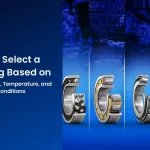
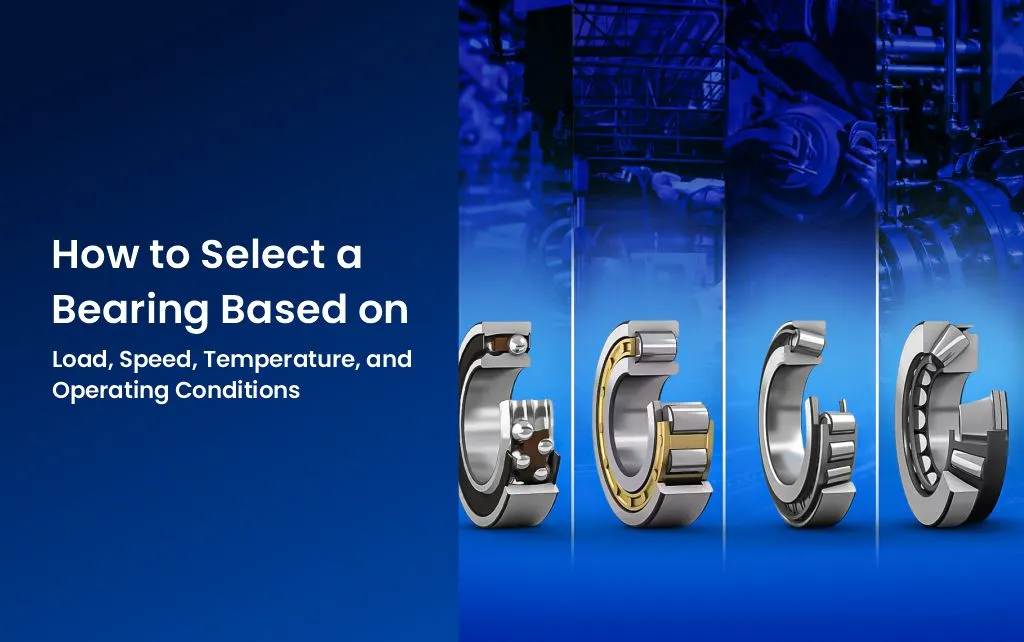
How Do You Choose Between Ball and Roller Bearings?
Bearing type selection should follow directly from the load, speed, and environmental factors already established, rather than from habit or availability.
- Ball bearings generally suit applications with moderate radial load, some capacity for axial load depending on design, and a need for higher speed capability with lower friction.
- Cylindrical roller bearings suit applications with high radial load and limited or no axial load, where line contact between rollers and raceway provides higher radial capacity than a ball bearing of similar size.
- Tapered roller bearings suit applications with combined radial and axial load, particularly where load direction is consistent, such as in gearboxes and wheel hubs.
- Spherical roller bearings suit heavy radial and moderate axial loads combined with a need to tolerate shaft misalignment or housing deflection.
- Needle roller bearings suit applications where radial space is limited but radial load capacity still needs to be relatively high.
- Thrust bearings suit applications where axial load dominates and radial load is minimal, such as vertical shaft arrangements.
None of these categories is a universal answer. A spherical roller bearing is not automatically “stronger” than a ball bearing in every sense; it is suited to a different combination of load, misalignment tolerance, and speed range. Choosing between them requires matching the category’s characteristics to the actual application profile established earlier, not assuming that a larger or heavier-looking bearing performs better by default.
Bearing Selection Decision Framework
When we review bearing requirements for machinery, we work through the same sequence regardless of the industry or equipment type. Following this order prevents the common mistake of jumping straight to a part number.
- Identify the load. Establish radial load, axial load, whether they act together, whether loading is steady or includes shock, and whether it varies through the duty cycle.
- Establish operating speed. Determine continuous and intermittent speed, and how speed interacts with heat generation and lubrication.
- Determine operating temperature. Establish ambient temperature, expected internal operating temperature, and any temperature peaks.
- Evaluate the operating environment. Identify dust, moisture, chemical exposure, washdown conditions, or general contamination levels.
- Evaluate alignment and installation. Check shaft and housing tolerances, expected fits, mounting method, and whether misalignment is likely.
- Check lubrication requirements. Decide between grease and oil, confirm viscosity suitability for the expected temperature and speed, and establish relubrication intervals.
- Select the appropriate bearing type. Match the load, speed, and environmental profile to a bearing category, then confirm sizing against the required dynamic load rating and life expectation.
This sequence, application through to final selection, keeps dimensional fit as the last confirmation step rather than the first decision.
Operating Factor Comparison Table
| Operating Factor | What to Check | Why It Matters | Bearing Selection Impact |
| Load | Radial, axial, combined, shock, direction, variability | Determines stress on raceways and rolling elements over time | Influences bearing type, internal design, and required dynamic load rating |
| Speed | Continuous vs intermittent, peak rpm | Affects heat generation and lubricant film stability | Influences bearing type, cage design, and lubrication method |
| Temperature | Ambient, operating, peak, lubricant limits | Alters internal clearance, lubricant viscosity, and seal integrity | Influences clearance class, seal material, and lubricant selection |
| Lubrication | Grease vs oil, viscosity, relubrication interval | Maintains separation between rolling elements and raceway | Influences seal type, relubrication frequency, and bearing life |
| Contamination | Dust, dirt, moisture, chemicals | Abrasive wear and lubricant degradation accelerate failure | Influences seal or shield configuration |
| Misalignment | Shaft/housing tolerance, coupling condition | Uneven load distribution across rolling elements | Influences choice of self-aligning bearing types |
| Shock/Vibration | Startup surges, unbalance, impact loading | Introduces transient loads above steady-state calculations | Influences required load rating margin and bearing type |
| Duty Cycle | Operating hours, load and speed variation over time | Determines real-world fatigue exposure, not just peak conditions | Influences life calculation and maintenance interval planning |
Common Bearing Selection Mistakes
- Selecting only by bore diameter. Dimensional fit confirms the bearing will physically mount on the shaft; it says nothing about whether it will survive the application.
- Ignoring axial load. A bearing rated well for radial load but not evaluated for axial thrust will wear unevenly or fail early under combined loading.
- Ignoring shock loads. Using average load figures without accounting for startup or impact loading understates the actual stress the bearing will see.
- Ignoring operating speed. A bearing that meets load requirements can still overheat if speed and lubrication were not evaluated together.
- Ignoring temperature. Overlooking operating temperature leads to incorrect clearance selection and lubricant breakdown.
- Choosing a bearing solely because it physically fits. Physical fit is necessary but not sufficient for correct selection.
- Ignoring lubrication requirements. Using a lubricant not suited to the speed or temperature range shortens relubrication intervals and bearing life.
- Ignoring contamination. Selecting an open bearing configuration for a contaminated environment invites abrasive wear.
- Using incorrect internal clearance. Standard clearance may not suit applications with elevated operating temperature or interference fits.
- Overlooking misalignment. Installing a rigid bearing type in an application with known misalignment leads to uneven loading and premature fatigue.
- Selecting an unsuitable seal configuration. Seals that do not match the contamination or temperature profile fail to protect the bearing internally.
- Assuming a larger bearing automatically provides better performance. Oversizing does not correct a mismatch in load direction, speed suitability, or sealing, and can introduce its own space and cost problems.
- Replacing an existing bearing without checking original application requirements. If the original bearing was undersized or misapplied, replacing it identically repeats the same failure.
- Failing to consider the complete duty cycle. Selecting for average conditions while ignoring startup, peak, and shutdown conditions leaves the bearing exposed during the most demanding parts of the cycle.
- Treating bearing selection as a procurement-only decision. Sourcing the correct part number matters, but the underlying engineering evaluation has to happen first; procurement teams that receive complete application information from engineering are far better positioned to source the right bearing rather than the closest dimensional match.
Pre-Purchase Bearing Selection Checklist
Before requesting or specifying a bearing, collect the following information:
- Radial load (magnitude and direction)
- Axial load (magnitude and direction), if present
- Whether loading is steady, cyclical, or subject to shock
- Rotational speed (continuous and peak)
- Whether operation is continuous or intermittent
- Ambient temperature and expected operating temperature
- Any expected temperature peaks or upset conditions
- Lubrication method available (grease or oil) and relubrication feasibility
- Environmental exposure: dust, moisture, chemicals, washdown
- Shaft and housing tolerances and expected fits
- Known or expected misalignment
- Available radial and axial space for the bearing
- Expected duty cycle and required service life
- Mounting and dismounting method planned for installation
A procurement request built on this information gives a bearing importer or technical supplier what is actually needed to recommend a suitable specification, rather than guessing from a bore size alone.
When Application-Specific Engineering Review Is Needed
General guidance can point an engineer toward the right category of bearing and the right questions to ask, but it cannot replace an application-specific calculation where precise life expectancy, exact dynamic load rating, or a borderline temperature and speed combination is involved. Where load, speed, and temperature figures are close to a bearing’s rated limits, or where the duty cycle is complex, it is worth confirming the selection against actual application data rather than general guidance alone. Being transparent about this limitation is part of making a sound selection decision, not a weakness in the process.
Conclusion
Correct bearing selection is a sequence, not a single lookup. Load, speed, temperature, lubrication, environment, alignment, and duty cycle all interact, and a bearing that appears to fit correctly can still be the wrong choice if any of these factors were left unchecked. The engineers and maintenance teams who see the fewest premature failures are consistently the ones who evaluate the complete application before comparing part numbers, not after.
At S. Goel Bearing & Co., this same sequence, load, speed, temperature, and operating conditions evaluated together, is how we help customers work through bearing selection for industrial equipment. Whether you are sourcing through a bearing importer for a specific application or working with a ball bearings importer to match availability against a technical specification, having complete operating condition data ready before you request a bearing makes the difference between a specification that lasts and one that gets replaced again in a few months.
If you are specifying a bearing for demanding industrial machinery and want to work through load, speed, temperature, and operating conditions before finalizing a selection, S. Goel Bearing & Co. can support that evaluation and help match the application to the correct bearing type and specification.