
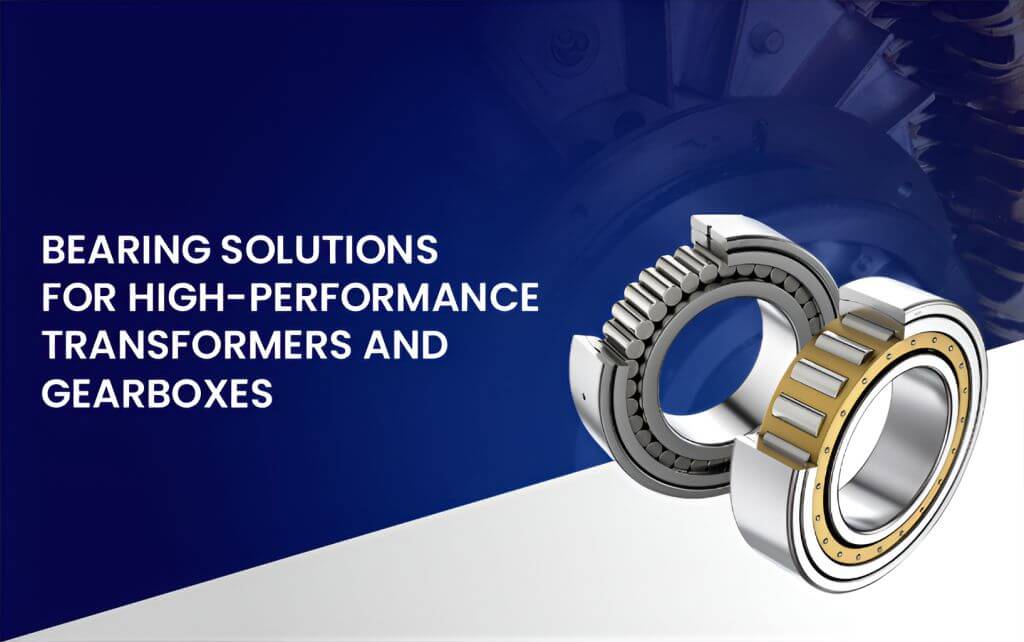
When you think of power plants, you can just imagine giant turbines, noisy generators, and thick cables transmitting electricity. But behind the scenes, there are several small components working hard to keep the big machines running smoothly. Among them are the bearings that are so completely silent, but they play a very important role. In this guide, you can learn everything about how bearing solutions support important systems and power plants.
Role of bearings in Transformers and gear reduction systems
Bearings are actually small mechanical components that help reduce friction between moving parts. In simple terms, you can say that they help parts rotate smoothly and support loads, allowing your machines to work effectively without overheating or wearing out too quickly. In power plants, bearings are basically used in cooling fans of Transformers or even oil pumps and auxiliary drives. No doubt, Transformers and gearboxes serve different purposes, but they just rely on bearings to keep things turning quietly and effectively.
Use case
Transformers are responsible for changing voltage levels in your power plants. They step up the voltage of the transmission and also step it down for distribution. During operation, Transformers generate a lot of heat that must be controlled to prevent damage. Transformers are basically equipped with cooling fans. It helps you maintain safe operating temperatures and also increases the transformer’s lifespan. It helps in avoiding overheating and electrical failures. These fans are powered by complete small motors, and at the heart of those motors are bearings
What kind of bearings are actually used?
Cooling fans usually spin at high speeds and operate for a long time. So when you choose the bearings, you need to ensure that there is low friction to allow smooth rotation, durability for continuous operation, and low maintenance because of limited accessibility.
Here, deep groove ball bearings are standard because of their simplicity, speed tolerance, and quiet operation. Even sealed bearings are used because the sealed designs prevent dust and moisture from entering, which is very important for outdoor transformer environments. High-temperature bearings are generally used in hot climates or where cooling systems operate near heat exchangers. If the bearings end up failing, the fan stops rotating, cooling systems break down and the transformer overheats. You can expect costly damage or a complete transformer failure.
Bearings in high-load gearbox applications in power plants
A gearbox is basically a mechanical system that changes the speed and torque of a rotating shaft. It reduces the speed of the motor while increasing the torque, which is very important for heavy machinery like coal conveyors, boiler feed pumps, wind turbines, and hydro-mechanical systems. Inside the gearboxes, there are a lot of moving parts, including the shaft, the gears, and of course, the bearings.
Bearings in the gearboxes support both radial and axial loads. They need to withstand vibration, high-speed rotation, and shock loads. Choosing the right wear means fewer breakdowns and lower maintenance.
Types of bearings commonly used
Tapered roller bearings handle both radial and axial loads. They are your best bet if you have gearboxes where gear alignment is very important and load transfer happens in angled paths. Spherical roller bearings are perfect for misaligned shafts. They tolerate the bending and vibrations without failing. Cylindrical roller bearings are great for high radial loads and smooth motion in high-speed gearboxes.
Bearing problems in gearboxes
If you use the wrong bearing or install it poorly, the results can be really serious, like gear misalignment or even overheating due to friction, broken gear teeth, and shaft damage. Just imagine a gear reducer driving a coal conveyor belt. If its bearing fails, the whole belt stops. The result? Power production slows, coal supplies are disrupted, and the downtime cost could run into lakhs of rupees per hour. Proper bearing design selection and fit go way beyond an option; it’s actually essential.
Improving reliability with poor materials selection and fit
The performance of a bearing doesn’t depend only on its type; it actually depends on the material it’s made from and how it fits in the machine. You need to choose the right bearing material, like Chrome steel is standard for most industrial bearings, and stainless steel is rust-resistant and good for outdoor and damp environments. Ceramic or hybrid bearings have a ceramic ball and steel races. It’s completely lightweight and corrosion resistant. At the same time, it is amazing for high speed and electrical insulation.
A bearing can fail or leave just because it was too tight or too loose. The correct fit depends on the operating speed, load direction, and size, besides shaft material and tolerance. 2 tight means generate heat, reducing bearing clearance, and two loose causes vibration and misalignment.
So above all, you need to know that beddings might be completely small, but they carry a big responsibility in the world of power generation. Whether it’s a gaping transformer or running a heavy gearbox right bearing choice can reduce downtime, prevent damage, and also save on thousands of repair costs